Home Home

Friday, May 24th, 2013


Derek Anderson

What every aspiring
author and illustrator
should know
about getting published

~ Part Three ~
Make yourself a student

I rediscovered children's books during my senior year in college. My mother, who was a grade school teacher at the time, had traveled to the International Reading Association Convention in Florida and returned with stacks of new children's picture books. I came home from college one weekend and found the books covering the kitchen table. I hadn't taken a look at a children's book since I was a kid. They were absolutely amazing. The stories were engaging and well written and so much fun. And the pictures were works of art. There were no limitations to what a storyteller with a big imagination could do. That was when I knew I wanted to make children's books.

There's usually a revelation of some kind for people who want to do this. But writing engaging stories and creating strong works of art is only the beginning of the journey. Getting the work in front of the people that decide what gets published is another.

Let's say you're a writer or artist and you're making things- great, interesting and original things! You've practiced, made mistakes and discovered your strengths and weaknesses. You've revised your work and you have something special you'd love to show a publisher. Now what? You don't have an uncle that works in publishing, you don't have any friends that are authors or illustrators and you don't have the first idea about where to go or what to do.

You can't get into a business that you don't know anything about. If you wrote a script for a movie, you wouldn't send it to a movie star and ask them to star in your movie. The publishing world is no different. If you've written a story, you don't send it to a children's book artist and ask them to illustrate your book. It's not a book. Not yet. Publishers produce books. Editors work for publishers. And editors are the ones that decide what will be published.

That all sounds easy enough, doesn't it? Just pop your story into an envelope and send it off to an editor. It's a bit more complicated than that. You can't pick a random children's book editor and send him or her your work. Editors aren't generic, faceless robots that are open to any story for any age and in any style. They're people with highly individualized sensibilities, personal likes and dislikes, and tastes just like everybody else. A children's book creator's goal is to connect with an editor that likes what you do, shares your sensibilities and will challenge you and push you to do your very best work. Your picture book story could be clever and original, but if you send it to an editor that only edits young adult novels or middle grade chapter books, you're wasting your time.

You have to do your homework. That's why it's so important to get educated about the business you want to get into. Locating the right editor at the right house is only the first step of many. What happens when you don't hear from the editor for two months? Or ten? And what happens when you finally get a form letter stating they don't accept "unsolicited manuscripts?" What does that mean? Can you send it to more than one editor at a time? Should you try to find an agent first? There are more questions than I can possibly answer here. And the answers can be different for every author and artist depending on who you are, what you've published and what you want for your career. You have to take each question as it comes, evaluate it, consult someone if you have to and do what's right for you. Some authors and artists prefer agents. I have an attorney. Some work with only one editor at one publishing house. Some have multiple editors at multiple publishing houses. You're competing with thousands (or even tens of thousands) of writers and artists that want to be published. Those that know their stuff are going to have a better chance at beating the odds.

Here are three steps I strongly recommend taking:


1. Do your research

That means read, read, read! Not just books about getting published. Read what's being published in the genre you want to get into. Become an expert on publishers, the imprints and what they specialize in. Know what the benefits are of publishing with a smaller house over a larger one and vice versa. You have to spend time in bookstores and libraries buying, checking out and reading books. Study what the artists and writers are doing. Not so you can copy them, it's so you can be aware of other perspectives, sensibilities and approaches. Reading good writing doesn't take anything away from your own work. It adds to your depth. But not everyone is interested in playing in the deep end of the pool.

Early in my career, I was signing books at a children's book conference and had an opportunity to hear a couple of the speakers. I will never forget one author. He was on stage, speaking about his chapter book for children which was, to my knowledge, the only book he's ever published. Someone in the audience asked him what some of the children's books were that he enjoyed reading. He leered at the woman who asked the question and said, "I don't read children's books because I'm not a child." You could feel the collective air let out of the room. That's certainly an interesting point of view. I don't know how anyone can call himself a writer and not be aware of what anyone else is doing in the arena. Writers are readers. We have a love of words and stories. I read everything from picture books, early readers and middle grade novels to graphic novels, YA, and both fiction and nonfiction for adults (I'm a little obsessed with biographies of artists and writers). Literature is just that, literature. It doesn't matter whether it's intended for a six year old, a sixteen year old or a sixty year old. If it's well written and interesting, I enjoy it.

Your research, however, should go beyond content. You should recognize what makes a good cover. You should know that most children's picture books are thirty-two pages (or a multiple of eight) and why. You should know how printed endpapers can change the page count of a book. You have to make children's books your obsession. That's what I did. Before I was published, I made it my business to know what authors and illustrators were doing, who they were publishing with and why that publisher may or may not be a good place to send my work. And the resources now are much more plentiful than when I was trying to get published.

SCBWI

2. Join SCBWI

SCBWI stands for Society of Children's Book Writers and Illustrators. It's an international organization for both aspiring and published authors and illustrators. They have chapters in every state in the U.S. and a number of them abroad, as well. They hold both local and national conferences where they invite editors, art directors, authors, artists and agents to speak about the nuts and bolts of the children's publishing business. I've spoken at their conferences. If you're interested in getting published, I would urge you to attend a local conference in a city near you. It's a great way to meet people in the business, find answers to your questions and connect with others that are trying to do the same thing you are.

Children's Writer's and Illustrator's Market

3. Buy a copy of Children's Writer's and Illustrator's Market

It's the go-to "how to" on getting published and can be found in the reference section of most large bookstores. It's a great resource full of nearly every active publisher, their imprints, names of acquiring editors, addresses and even the kinds of books they're looking for. You'll also find agent listings, magazine contacts and other markets for your artwork and stories. It's updated every year, so make sure you buy the most recent edition.


I've certainly loaded a lot on your plate. Before you start in with excuses for why you don't have time to write, draw, do research, read, join organizations, go to conferences and learn about the publishing business, consider how important this dream is to you. You have to make sacrifices for the things you want. We all do. There isn't enough time, money or room in our comfort zones to have everything we want and stay the way we are. Sometimes the obstacles that exist in our minds are far greater than the obstacles that exist in the world. Just remember there are two ways to look at anything. You can look at it as a burden, or you can look at it as an adventure. It's all a matter of perspective.

Coming next week: Part Four: Dealing with rejection


You can visit SCBWI's website HERE.
You can buy a copy of Children's Writer's & Illustrator's Market HERE.


Paint

Friday, May 17th, 2013


An early painting from before I was published.
Acrylic on canvas from 1998 or 1999

What every aspiring
author and illustrator
should know
about getting published

~ Part Two ~
Do the work

I landed my first job at the ripe old age of eight. That's right, eight years old. It was delivering papers. I know that sounds young, but my parents didn't give us allowances so my brothers and I learned very early on that we had to work for what we wanted. The paper route was only once a week. It was an advertiser so the papers were thick and heavy and I had around a hundred houses on my route. Each Wednesday, I loaded the papers into my wagon and walked up and down block after block distributing them. I never knew what I would encounter on the route. There were loose dogs, busy streets to cross, thunderstorms in the summer and blizzards in the winter. I couldn't let any of those obstacles get in the way of what I needed to do. I had to choose one house on one street and get started. It seems simple enough doesn't it? That's how you conquer anything.

For some reason, people don't treat writing stories and creating artwork the same way. Believe it or not, there are people that say they have ideas and they want to be published, but they never actually make anything.

If someone has an idea for an invention that could change the world, but they never make it, guess what's going to happen? Nothing. And I don't care how good your idea for a book or picture is, if you don't take the time to write it or draw it, and give it a chance to become something, it won't become anything.

There's a not-so-secret ingredient to writing and illustrating books... you have to do the work. Having a great idea for a story isn't enough. Publishers don't buy ideas. They need to see real stories from writers and real pictures from artists. You have to put your ideas to the test. And when you do you're going to discover one of those truths about creating that's also a truth about life:

Things hardly ever, almost never go as planned.

I can understand that people are afraid. It's a scary thing to face your fears and actually do the thing you dream of. It's safer to not do it. Some are happy with that perfect, ideal image of what would happen if they took a step toward their dream. They know they'd be wildly successful. So let's ride that dream train together for a second. Wouldn't it be wonderful to create something so amazing that the second it arrives on a publisher's desk, they have to have it and frantically call you offering a book contract and a giant advance. When your book is published, it's translated into foreign languages and becomes a sensation around the world. Newspapers and magazines fight with one another, scrambling to be the first to interview you. Piers Morgan, Charlie Rose and Ellen DeGeneres want to talk to you about how great you are and, of course, Matt Lauer calls about an appearance on the Today show. The world is watching, in awe, as you ride the bestseller lists to the top, graciously bowing before the endless applause and accolades. Hey, snap out of it. It's a nice dream... but it has nothing to do with the act of creating anything. That one's all about a need for recognition. Forget fame, applause and accolades. The writers and artists that get published and succeed in this business do it because we have to create. We need to make interesting characters and worlds that challenge us and push us beyond our abilities.

Creating stories and pictures is hard. It takes a lot of practice. You'll quickly find that stories often go nowhere, and artwork rarely turns out the way you thought it would. That's where it begins. You'll study it and ponder it and ask yourself what went wrong. You'll discover why it didn't work and how to make it better and the most amazing thing will happen while you do. You'll grow. That's what makes creating so exciting. There are big surprises. You'll find a perfect direction for your story that you never expected. Or a new character will come wandering into your artwork that you didn't invite.

The work begins for both writers and artists with a simple toolbox. I'm not talking about monkey wrenches and power drills here. It's your own, personal set of creative devices. It begins with paper, pens, laptops and sketchbooks. But the rest of your creative toolbox is stocked with skills that are developed through the act of making things.

For writers- you have to find your own voice. And just what does that mean? It means you have a unique way of telling a story. Find it. It's your palette. It's how you create characters and make them sympathetic. It's how you engage the reader and take them on a journey. It involves language, dialogue and how you handle tension. You don't learn these things by writing one story and saying, "Bring on the publishers." You need to study people and discover what motivates them to behave the way they do. You need to listen to how people speak. You need to learn to describe your invented world with such intoxicating clarity that your reader can see what you see. But you have to do it with as few words as possible. The job of the author isn't to wow the reader with your language, it's to make the words disappear. A story should pull a reader in so deeply, they forget they're reading.

A writer should know the difference between first person, third person and third person omniscient narratives and what the strengths and limitations are of each one. If you don't, you need to take a fiction writing class before you show your stories to anyone. Those are the very basic tools of a writer. It isn't necessary to know how to spot a dangling participle to tell a good story. But you do need to have a strong enough grasp of English to edit your work. A writer should never, under any circumstances, submit a first draft of anything.

For artists- you have to find your voice, too. Your visual voice. It's what makes the look and feel of your work unique and different from what everyone else is doing. It isn't just about brushes, painting surface and palette. You have to learn what makes a good, strong composition. You have to create characters and give them personalities beyond what exists in a text. You have to be able to render them from different angles, with different expressions and gestures, and keep the palette, the world and the details relatively the same from one picture to the next. You have to learn how to carry a narrative and make actions clear at a glance. And pacing is a crucial part of every children's picture book. You're telling a story visually and you have to keep your reader turning the pages in anticipation. It may look easy. In fact, I'm sure it does. But anyone that's ever said it's easy to make a book has never made one. It takes a lot of effort to make something appear effortless.

Aspiring writers and book artists need to face hard truths. You need to ask yourself if you're really ready. What do you have trouble writing or drawing? What are your weaknesses? Once you go pro, you don't get the luxury of waiting for inspiration to come. There are deadlines to meet. You need to have strong instincts and be ready to create without hesitation. Paying your dues isn't about passing time, it's about developing all aspects of your creative abilities. Your job is to make your work come to life.

The road to publication isn't easy. It's long, bumpy and littered with potholes, obstacles and a whole lot of parking places. No one knows what's going to happen when we set out on it. But that's also true of life. Whether you're an eight year old with a paper route or a grownup with a full time job and a dream, sometimes you just have to choose a place to begin and get started.


Paint

Friday, May 10th, 2013


Derek Anderson

What every aspiring
author and illustrator
should know
about getting published

~ Part One ~

Making a living as an artist and writer goes against nearly everything we're taught when we're growing up. The conventional path is to find a pursuit that interests you, go to college for it and hopefully find a full time job doing exactly that. It doesn't always work that way if you're interested in a pursuit that's unconventional.

When I was in college at Iowa State University, I studied Fine Art with an emphasis in drawing, painting and printmaking and I took every fiction writing class the university offered. Upon telling that to new acquaintances, they'd always ask the same thing, "But what are you going to do when you get out of school?" People just don't go on to become artists and authors. Or at least most don't. And if you don't believe you can make a living as an artist, why try?

I can tell you one thing for certain... if you don't try, it will never happen.

Writing and illustrating books is one of those unconventional jobs that no one quite knows how to get into. There isn't a building where you go apply for this job. This isn't a forty hour-a-week position, you don't get paid every two weeks and no one seems to care where you went to school or for what. And books cost a lot of money to make, so publishers are careful about hiring people that have never made one before. It's all a bit confusing for someone trying to break into this business.

For some reason, there's a notion out there that published children's book artists have the keys to the back door of the publishing business. That we are the answer to their publishing dreams. You would not believe how many aspiring authors email me every month asking me to illustrate their stories. That's simply not how this business works. I always write back with a short list of steps they should take to learn about the business of children's books and how it works. If they're serious, they'll take those steps and learn the proper etiquette for submitting their work to publishers. My guess is most of them get discouraged and quit. It's hard work to get published. It takes more than an ability to write good stories and draw and paint good pictures. That's only the beginning.

Getting published is like chasing any dream. There isn't a magic pill or a short cut. You can seek out people that have done it and ask their advice. You might stumble onto an insider's tip or a secret method someone else used. But ultimately, they can't do it for you. Eventually, you have to decide that this is something that's important to you and begin to work at it. Getting published can take months or, more likely, years. You're going to get rejected. Probably a lot. You're going to get criticized. Probably a lot. You're going to work for long stretches with what may seem like little or no results. There will be friends and people you meet that will ask you why you're wasting your time. And, of course, there's no guarantee that your dream will ever come true. Discouraging? It can be. It all depends on how you look at it. But here's the good news- if you're passionate, driven to create and willing to keep trying new things, it could happen.

Years ago, before I was published, I was having a conversation with a friend. "What will you do," he asked, "if this dream doesn't come true? Because it might not, you know." I was a little surprised by the question. But I realized, at that moment, that he didn't really know me. He had no idea what I was truly capable of. How could he? A point of view is exactly that- a point of view. People see things from their own limited set of experiences. He couldn't see the world from the same vantage point I did. This dream wasn't really a dream anymore. It had become a goal that I was absolutely committed to. I would never give up. Ever. I literally couldn't be broken. If it was possible for anyone to be published in a lifetime, it would happen to me. It didn't matter how long it would take, how many pictures I had to paint or how many stories I had to write. I was in it for the long haul. It took three more years after that conversation before I got my first publishing deal. Those weren't easy years, but it was worth the wait.

Over the next weeks, I'll tell you about the road to publication and how you can set out on it. If you're not interested in getting published, come along anyway. I have some fun stories to tell. I'll tell you how I learned about the business of children's publishing, how I kept from drowning in the endless stream of rejection letters, constant criticism and one failure after another.

The rest will be up to you.


Paint

Friday, May 3rd, 2013


Snowglobe

Life in a snowglobe
And other news...

Do you ever feel like you're living inside a toy on Jack Frost's shelf? We do in Minneapolis. It's snowing again, and it's May. It's May! May.

Fortunately, we got some warm, sunny news to chase away those winter blues... Hot Rod Hamster just won another awesome award! Wyoming's Buckaroo Award is voted on by students in grades Kindergarten through 3rd and our Hamster man won! Rip-roaring thanks to our young buckaroo friends in the state of Wyoming for this great honor! Hot Rod Hamster will don his cowboy hat and take a victory lap now.

Hot Rod Hamster


Paint

Friday, April 26th, 2013


Pig

17" X 13" Acrylic on paper, 2011

Once upon a rainy day...

I'm always experimenting with characters, palette and painting effects when I'm not on deadline for a book. Experimentation is a part of every artist's growth and development. We have to peel away expectations, forget the roads we've already traveled and search inside ourselves for new and interesting directions. I painted this fellow in April 2011. I don't know if it was raining at the time or if I just wanted to explore drizzly rain effects. I laid in the atmosphere and ground with as little brushwork as possible to keep the focus on the character. This pig has a bit of mystery to him with his umbrella, glasses, hat and overcoat, so I gave the painting a title that reflects that curiosity...

"He couldn't even remember why he'd come here.
But he was glad he came, glad indeed."

It's a long title that doesn't give you any answers. It just causes you to want to know more, which is exactly what a good painting should do.


Friday, April 19th, 2013


Einstein

A word from Mr. Einstein

There isn't a lot that needs to be said about this one. But it's something our federal government and nearly every big corporation in America should listen to...

"Any intelligent fool can make things bigger and more complex...
It takes a touch of genius- and a lot of courage to move in the
opposite direction."
-Albert Einstein


Paint

Friday, April 12th, 2013


Hot Rod Hamster

Hot Rod Hamster WINS
Mississippi's Magnolia Award!
And other news...

It was just announced... Our speedy Hamster man is taking home another trophy! Hot Rod Hamster won the 2013 Magnolia Award, a children's choice award voted on by students in the state of Mississippi. Hot Rod Hamster won in the Kindergarten through Second grade category. He's jumping for joy over this terrific award! Go Hamster!!!

Waking Dragons

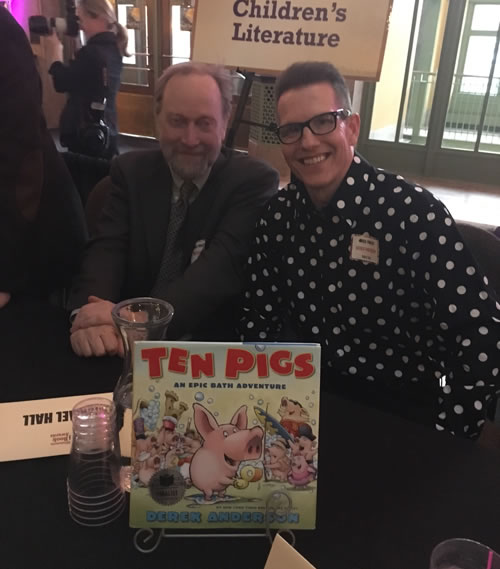
And... the Minnesota Book Awards Gala is this Saturday night (April 13th). Waking Dragons is a finalist in the Children's Literature category. We have our dragon fingers (and tails) crossed. We're looking forward to a fun evening with the Minnesota literary community. The awards will be televised at a later date.

Spring in Minnesota

And finally... a grumble. Yes, a grumble. Either Mother Nature has overslept or she's in cahoots with Old Man Winter. In case you hadn't noticed, it's mid-April, which usually means spring. And this is the view outside my window. How am I supposed to frolic in flowery meadows and bask in the endless blue, sun-soaked skies when the world is still gray and covered with snow? It's time for winter to go. Mother Nature is getting dangerously close to being charged with some sort of fraud. We've done our time, the holidays were three months ago. It's time for spring... please!


Paint

Friday, April 5th, 2013


Monet

A portrait of artist Claude Monet by Derek Anderson

Monet's Garden

I brought something back from Paris, France. I guess you could call it a souvenir, but I didn't buy it. It's a rock. Not a pet rock or polished rock, not even a fancy rock. It's a plain, white rock. I know, I know, it doesn't sound very special. But it's special to me.

For our tenth wedding anniversary, my wife, Cheryl, and I traveled to Paris to celebrate. It's an absolutely intoxicating city. It's one of those exotic places that's so rich with history, arts and culture, you can't possibly see everything you need to see in a week. We certainly tried. We saw the Palace of Versailles, the Louvre, Musee d'Orsay and Notre Dame. Cheryl dragged me to the top of the Eiffel Tower (I'm terrified of heights, but that's another story for another time). We had a drink at Les Deux Magots, a famous cafe where Picasso, Hemingway, F. Scott Fitzgerald and other artists and writers would gather in the 1920s. We visited l'Orangerie (my favorite Parisian museum) and walked the Avenue des Champs Elysess. But the most amazing part of the trip, for Cheryl and I, was visiting Giverny. Giverny is a tiny little town outside of Paris where the artist Claude Monet lived and worked.

Claude Monet was the father of Impressionism and he's one of my favorite artists. He had his gardens constructed and planted because when he gained fame in the late 1800s, his neighbors began demanding money when he painted pictures of their haystacks, their trees and the scenery that was in plain view in the Giverny countryside.

Monet's Garden

The gardens and its bridges are where Monet painted his water lily paintings and so many other amazing works. The gardens are still there, rich with life. They're bursting with color and flowers and trees. It's so clear why Monet built this little paradise. The light spills through the foliage and decorates everything beneath in delicate, swaying shadows and patches of dancing sunlight. Cheryl and I spent an afternoon walking the gardens, touring Monet's home and studio and getting lost in this great artist's life.

As we were leaving Monet's home, our tour guide suggested we make one last stop. There's a small church just a short walk up the road. Claude Monet is buried there, in the church yard. I really wanted to see his grave, so Cheryl and I made the short trek up the road. I have to admit, I was surprised when we got there. I'm not sure what I was expecting, I've been to graves countless times in my life. It was a simple plot, surrounded with white rocks and an unremarkable headstone. But it ended up being a profound moment for me. We'd just spent the afternoon wandering through this artist's world- his home and gardens had been preserved very much the way he left them. It's strange to feel the energy of a large life and then experience the emptiness of its quiet resting place. Claude Monet's life was in his art and the work he left behind. How he died and where he was buried didn't matter. It was how he lived and what he did with his time while he was here that made a difference in the world. I will never forget that... I picked up a rock from his grave and brought it home to remind me.


Paint

Friday, March 29th, 2013


Derek and Jane Yolen

WAKING DRAGONS author Jane Yolen and artist Derek Anderson

Tea with Dragons!
And other news...

Jane Yolen, rock star author of Waking Dragons, was in Minneapolis this week (she lives in Massachusetts) and we met for a little tea and chat about publishing. Readers often assume that authors and artists know each other and work together when we're creating picture books. Though there are exceptions, that's rarely the case. Authors and artists are usually paired by the publisher and an editor's job is to work with each of us to push us, challenge us and try to get the best book out of us they can. It was fun to finally meet Jane in person and sit down for a talk about dragons, writing, painting and this crazy publishing business!

And in other news... Hot Rod Hamster made an appearance at a fun event in California. NASCAR driver Kyle Larson paid a visit to Oakmont Elementary School in Claremont, California in mid-March where he read Hot Rod Hamster to the students.

Hot Rod Hamster

The school won the visit by participating in a reading challenge sponsored by Auto Club Speedway, a racetrack in California. I'm so glad Hot Rod Hamster could be a part of their special day!

Hot Rod Hamster

Hot Rod Hamster

GO HAMSTER!

And finally... the kindergarten, first and second graders at Lincoln Elementary in Little Falls, Minnesota have been reading Hot Rod Hamster and Happy Birthday, Hamster and decided they wanted more Hamster adventures. They created book covers for the books they would like to see. Here are pictures of a few...

Hamster Ideas

Many thanks to media specialist, Emily Stenberg, for sending these along!

I have good news for Hot Rod Hamster's many friends at Lincoln Elementary and readers everywhere. There will be another Hamster adventure! The book is finished and we're in final stages of production. Hot Rod Hamster: Monster Truck Mania will be published by Scholastic Press in Spring 2014. This book is one fun ride!


Paint

Saturday, March 23rd, 2013


Derek Anderson

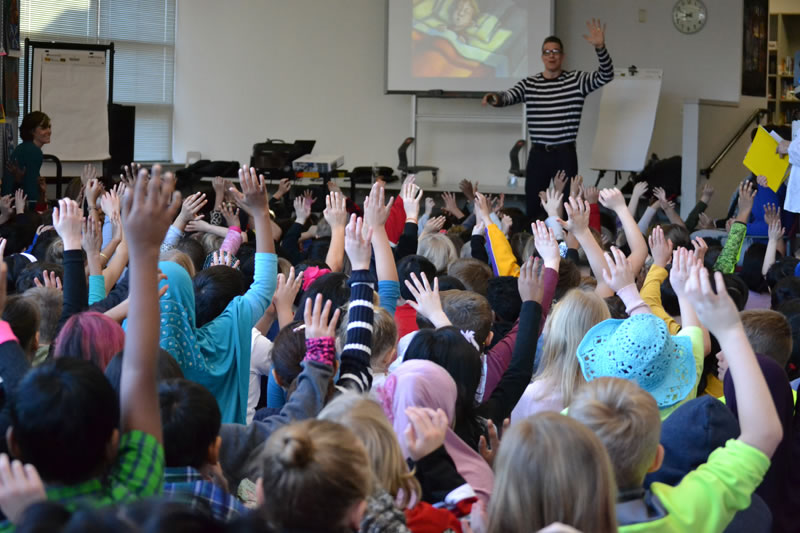
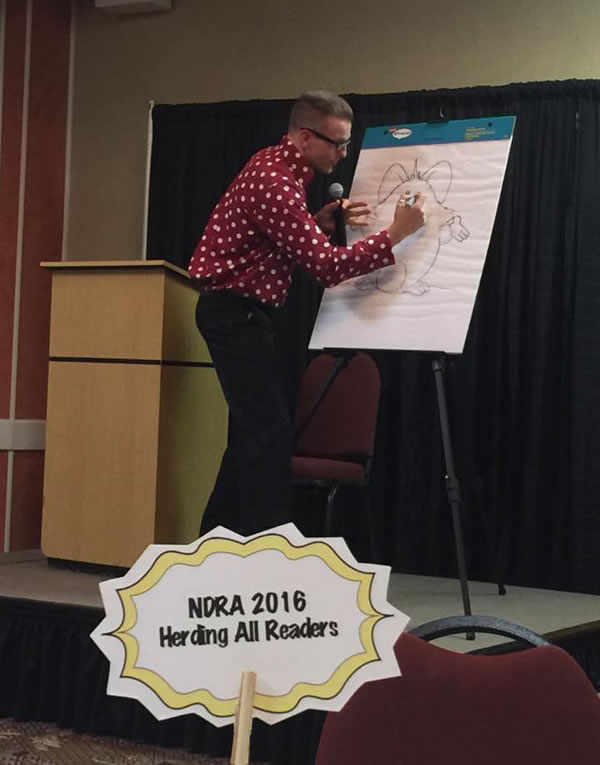
Derek speaking to students at Rogers Elementary School

The always unpredictable
SCHOOL VISIT

I spoke at Rogers Elementary School last week. It almost didn't happen.

We'd first scheduled my visit for early March. And old man winter, an all too common fixture who's still lounging around Minnesota in March, conjured a blizzard and school was cancelled for the day. We rescheduled for last Tuesday and on Monday night I went out to my car and discovered it wouldn't start. After jump-starting it with little success, a realization quickly came over me. I had no way to get to the school, 30 miles away, the next morning. A school visit isn't something that's planned on a whim. It's scheduled months in advance. I prepare for it for days. I want every student, teacher and staff member in that school to get everything they deserve- a first rate talk on creativity, writing, drawing and pursuing and accomplishing your dreams. And that's just my end of things. The media specialist (in this case, the AMAZING Roxanne Book) and teachers go to incredible lengths to prepare the students for an author visit. They read my books, they study what an author and illustrator does, they discuss creating and the critical thought behind it. They really spark the students' curiosity so they'll come to my session prepared with questions. And a stalled car, no matter how difficult an obstacle that is to overcome, can't get in the way of an important day like this one. This story has a happy ending- I rented a car late that night and was at the school bright and early the next morning. It was worth every penny.

Derek Anderson

Speaking to students and their parents at Rogers Elementary School's family night

My very first time visiting schools was more than ten years ago. I'd planned a day visiting multiple schools in my hometown of Ames, Iowa. I didn't charge an honorarium back then. I didn't know what I was doing yet. Unfortunately, I caught a bug the day before and was up sick that entire night. The next morning I was exhausted, but I couldn't cancel. I knew how important this was. I gathered up whatever energy I could muster and gave every presentation all I had. At the end of the day, I collapsed in a heap.

I've experienced everything imaginable since then. I once had a fire alarm go off in the middle of my presentation and I had to evacuate along with the students until we were cleared to return to the school. I've had equipment malfunctions, cell phones ring while I was speaking and at least one student projectile vomit in the middle of my presentation (I'd like to think that didn't have anything to do with me). Believe it or not, that wasn't the worst distraction I've had. I have a severe phobia about loose teeth, which, unfortunately, is common among the readers I speak to. Years ago, I was speaking to a group of about 300 and there was a boy sitting near the front of the audience. One of his front teeth was loose and ten minutes into my presentation, he latched onto that tooth and didn't stop wiggling it until I was finished speaking half an hour later. As a speaker, you learn very quickly that you can't control the audience, the distractions, or the many unpredictable things that might come along while you're speaking. You can only control yourself and how you react. I didn't react to that boy at all, but I was so acutely aware of it, I still cringe when I think of it now.

Derek Anderson

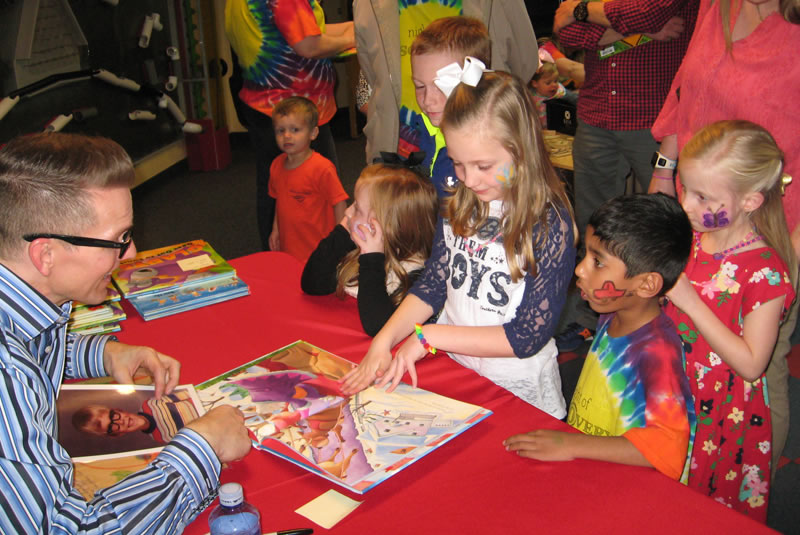
Signing WAKING DRAGONS for an enthusiastic reader

An author visit to a school isn't just about reading or books. It's about inspiring young people to use their imaginations and dream big dreams for their lives. The jobs we have as authors and illustrators aren't easy to come by. You don't fall into it by accident. I fought for this because I'm incredibly passionate about creating stories with words and pictures. Part of my job as an author and illustrator is to share that passion and the power of the imagination with students. It's not always easy to do that. There are snowstorms, stalled cars and other obstacles that get in the way. I plan and prepare for my presentations as much as I can, but I have to be ready for anything. The reality is that things don't always go as planned, which is a great metaphor for life.


Derek speaks in schools, libraries, bookstores and at conferences all over the United States. To check his availability for your school or event please contact his booking agent, Jean Dayton, at Dayton Bookings by clicking HERE.


Paint

Friday, March 8th, 2013


The Still Echo

A Simple Truth

One of the most interesting things about living this life is the often bumpy path of discovery that we travel each day, week, month and year. I think we're all after some kind of truth in this world. I can't think of any quote that's more true than this one by the great E.B. White, author of Charlotte's Web, Stuart Little and The Trumpet of the Swan...

"I get up every morning determined both to change the world and to have
one hell of a good time. Sometimes this makes planning the day difficult."

-E.B. White


Paint

Friday, March 1st, 2013


Otsego

Translation: "I like when Derek Anderson made a picture of the Hamster"

Derek Anderson

HUGE Hamster thanks to Roxanne Book for all the great photos!

Back to School

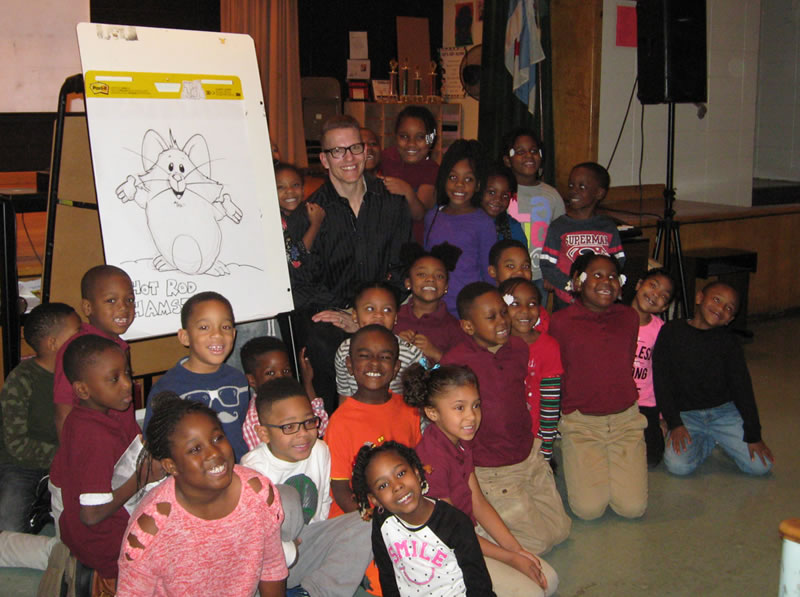
I was at Otsego Elementary School just outside of Minneapolis last week. I always love to speak to kids about creating stories and pictures for books. One of the most exciting things about visiting with students is seeing their amazing artwork. There's an honesty in children's artwork. They capture the essence of what they're drawing without fussing over the details or trying to make it perfect.

The drawing above is by a young student that drew a picture of me speaking at his school. I love how he rendered my hair and the stripes on my shirt and my black pants. And I love his drawing of Hot Rod Hamster on the easel. But what I love most is that he drew my right arm and hand much larger than my left. And the fact that he didn't worry about a neck or shoulders. I love the joy that comes across in the mouth. Is it perfect? No, it's not. The drawings and paintings I make aren't perfect either. Artwork isn't about being perfect. Artwork is about expression, which is why kids are so good at creating. They haven't yet become self conscious enough to judge themselves or their work. It's a lesson every grownup could learn from.


Paint

Friday, February 22nd, 2013


White House

All Hail...

In honor of Presidents' Day this week and George Washington's birthday today, I thought I would share something a bit different.

There's no question that the President of the United States is an important job. Those are some of the biggest shoes in the world to fill. And the men who have filled those shoes are just that-- men. Though they appear to be grandiose, larger than life figures, they are ordinary people with hopes, dreams, fears and eccentricities just like the rest of us. Here are some fun facts about a few of those men...

• Abraham Lincoln was notoriously messy.

• Theodore Roosevelt was a big fan of food- he often drank up to a gallon of coffee a day and sometimes ate a dozen hard boiled eggs for breakfast.

• The "S" in Harry S Truman doesn't stand for anything. His parents couldn't decide between "Shippe" and "Solomon" for a middle name, so it was just left as "S."

• Ronald Reagan was a notorious doodler and regularly doodled during boring meetings.

• George Washington is the only president that didn't live in the White House. During Washington's two terms as president, the capital of the United States was first in New York and then Philadelphia. The White House wasn't completed until after Washington's death.


Paint

Friday, February 15th, 2013


Derek and the Ducks

A question of fate or coincidence...
Another tale of Little Quack

After Little Quack was published, my mother called me one day. "Do you remember having a duck helmet when you were little?" she asked. I didn't. "I'm going to send you a picture," she said. "I think you're going to want to see this."

She sent me a long forgotten photo that had been buried in my scrapbook since childhood. When I was three or four years old, some friends from the neighborhood and I got duck helmets. I have no idea how we all ended up with exactly the same helmet. There were five of us ducky friends, and I recognize the yard- it's across the street from the house where I grew up.

Here's where things get strange...

Little Quack and the Ducklings

The very first picture I ever painted of Widdle, Waddle, Piddle, Puddle and Little Quack looks oddly similar to the photo. There are five ducklings in the picture and five ducky friends in the photo. Little Quack, on the far right in the picture above, is the shortest. That's me, on the far right in the photo, also the shortest. The second boy from the left in the photo is Neal Sturtz. Neal and I grew up next door to each other. Neal has red hair. If you look at the painting, Waddle is the second duckling from the left. He has red feathers.

When I set out to create the look of the characters for Little Quack, I needed to distinguish the ducklings from one another. Giving them distinct sizes, feather colors and do's was the only way I knew to do it. I sketched, painted and played with rough color pieces until I arrived at a look and personality for each that felt right.

As I said before, I'm not a big believer in fate. But this still gives me chills.


Older Posts

Derek Anderson • Derek Anderson • Author & Illustrator • Author • Illustrator • Children's Books • Painter • Artist • Art Blog • Waking Dragons • WAKING DRAGONS • Little Quack • LITTLE QUACK • Hot Rod Hamster • HOT ROD HAMSTER • Author • Artist • PAINTER • Children's Books • Simon & Schuster • Scholastic • Minneapolis